A Rogers building needs its insulation looked at when moisture keeps returning, the envelope no longer holds temperature evenly, or the material has been damaged or displaced. With seasonal swings and humidity management dominant in this climate, roof-deck condensation dripping onto racking and packaged goods tends to be the underlying story.
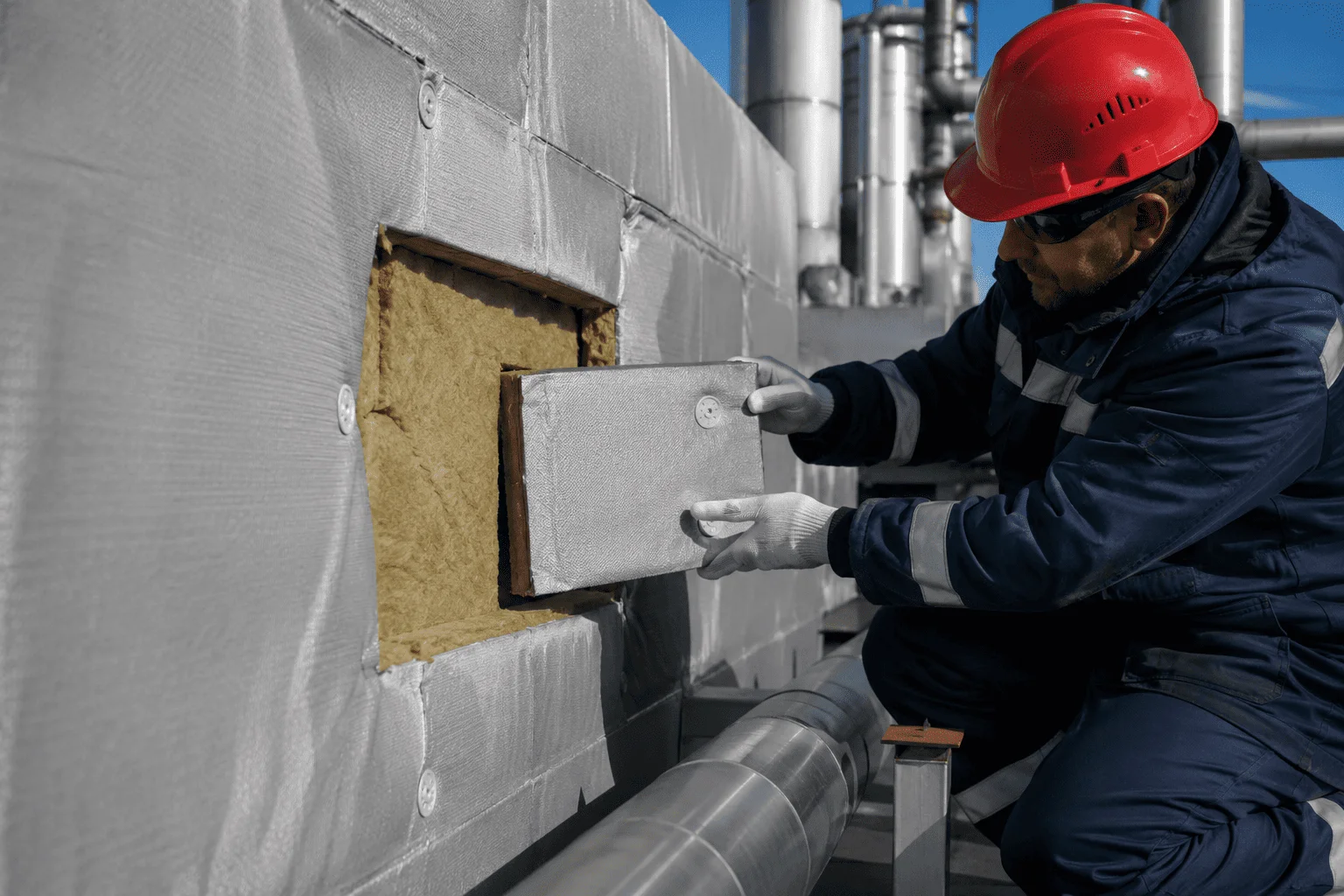
Why insulation stops working
Failure is normally cumulative rather than sudden: a roof leak here, a compressed batt there, an unsealed transition that never got detailed. Each is minor alone, and together they take an assembly well below the R-value it was specified to hold.
Local conditions that accelerate failure
In Rogers the pattern has a local accent. The mixed-humid climate makes seasonal swings and humidity management the leading envelope concern, and with a building stock shaped by a retail-supplier and distribution growth market, the failure we are called about most often in high-bay distribution space is roof-deck condensation dripping onto racking and packaged goods. Supplier-driven expansion keeps distribution and new commercial construction active. Buildings running distribution and retail supply operations tend to show it first, because the loads are constant and the consequences are visible on the floor.
What to look for
- Condensation and staining. If moisture returns in the same spots after every humid stretch, the assembly is not managing vapor. In Rogers this shows up early on supplier distribution centers and retail and commercial buildings.
- Uneven temperatures and drafts. Hot and cold zones across a floor plate, or air movement you can feel at transitions, point to leakage paths rather than an undersized system.
- Rising utility cost with flat operations. A distribution facility running the same schedule at higher demand is often paying for envelope losses rather than process changes.
- Post-incident conditions. After a roof leak or water event, affected insulation traps moisture against the structure. Drying it in place is not a durable fix.
- Material that is compressed, sagging, or gone. Insulation only performs at its installed thickness. Once crushed or displaced it is not delivering its rated value whatever the spec said.
Choosing between repair and replacement
Localized damage often needs nothing more than repair and re-sealing. Widespread degradation, contamination, or moisture damage usually means removal and replacement with a system matched to the assembly. The distinction matters because replacing a whole envelope when a transition detail failed is expensive and does not fix the cause.
What happens when we walk the building
We start where the symptoms are, then check whether the cause sits somewhere else in the assembly. Access matters as much as area in high-bay distribution space, because reaching a high deck changes both method and schedule. What comes back to you lists the removal, the system going in, the coverage, and how the work is staged.
If you manage buildings beyond Rogers, the same symptoms read the same way in Bentonville, Fayetteville, Springdale, though exposure and building age differ enough that each site is worth checking on its own.
Related pages
Frequently asked questions
Do you handle removal and disposal?+
Yes. Degraded or contaminated material is removed under containment and disposed of, then the new system goes in as part of the same job.
Can the work happen while we stay operational?+
Usually. Work in high-bay distribution space is phased, zones are isolated, and we coordinate with your facility and safety teams so supplier distribution centers keep running. That phasing is in the schedule, not hidden in the price.
How long does commercial insulation last in Rogers?+
There is no fixed lifespan. Kept dry and undisturbed, it performs for decades. Exposed to the seasonal swings and humidity management common here, or to leaks and trade damage, it can fall well short of its rated value in a fraction of that.
Will replacing insulation lower our energy cost?+
Usually, though how much depends on what failed. Restoring a compromised envelope in a distribution facility tends to show up first in HVAC runtime rather than in a single headline number.
How do I get a commercial insulation estimate in Rogers?+
Send the building type, approximate size, and what you are seeing. We will assess it and come back with a written estimate covering removal, the new system, and the schedule.
Planning a commercial or industrial project?
Tell us the building type, where it's located, and what you need done. We'll review the details and get back to you.
Prefer to call? (850) 639-9272