An Orlando building needs its insulation looked at when moisture keeps returning, the envelope no longer holds temperature evenly, or the material has been damaged or displaced. With moisture control and cooling-load reduction dominant in this climate, roof-deck condensation dripping onto racking and packaged goods tends to be the underlying story.
Why insulation stops working
Failure is normally cumulative rather than sudden: a roof leak here, a compressed batt there, an unsealed transition that never got detailed. Each is minor alone, and together they take an assembly well below the R-value it was specified to hold.
Local conditions that accelerate failure
In Orlando the pattern has a local accent. The hot, humid subtropical climate makes moisture control and cooling-load reduction the leading envelope concern, and with a building stock shaped by a hospitality, convention, and distribution market, the failure we are called about most often in high-bay distribution space is roof-deck condensation dripping onto racking and packaged goods. A hospitality-led economy plus expanding logistics space drives both comfort and large-span envelope work. Buildings running hospitality and conventions operations tend to show it first, because the loads are constant and the consequences are visible on the floor.
Five signs worth acting on
- Condensation and staining. If moisture returns in the same spots after every humid stretch, the assembly is not managing vapor. In Orlando this shows up early on hospitality and hotel properties and convention and event facilities.
- Zones that will not hold temperature. One end of the building comfortable and the other not is a leakage and gap problem far more often than a capacity problem.
- HVAC working harder for no obvious reason. If nothing changed on the floor but the equipment runs longer, the loss is usually through the envelope rather than the plant.
- Damage from other trades. Penetrations cut and never sealed, material pulled and not replaced. It is common in an active conventions building and it quietly undoes the envelope.
- Batts sagging out of the assembly. Fasteners fail, material slumps, and gaps open at the top of the cavity. What is left performs nothing like the number on the submittal.
How far the work needs to go
Localized damage often needs nothing more than repair and re-sealing. Widespread degradation, contamination, or moisture damage usually means removal and replacement with a system matched to the assembly. The distinction matters because replacing a whole envelope when a transition detail failed is expensive and does not fix the cause.
What happens when we walk the building
A walk-through covers the affected assemblies, the moisture conditions, and how crews would physically reach the work. That is enough to say whether the answer is repair, targeted replacement, or full re-insulation, and how it phases around your operations. The estimate then names removal and disposal, the new system, the coverage, and the schedule, so you are deciding on scope rather than a single number.
If you manage buildings beyond Orlando, the same symptoms read the same way in Boca Raton, Clearwater, Fort Lauderdale, though exposure and building age differ enough that each site is worth checking on its own.
Related pages
Frequently asked questions
How do I get a commercial insulation estimate in Orlando?+
Send the building type, approximate size, and what you are seeing. We will assess it and come back with a written estimate covering removal, the new system, and the schedule.
How do I know if my Orlando building needs new insulation?+
Look for condensation or staining, energy loads climbing without an operational cause, uneven temperatures, drafts at transitions, and material that is compressed or missing. Any one of those justifies a look at the envelope.
Is repair enough, or do I need full replacement?+
Localized damage with a known cause can often be repaired and re-sealed. Widespread or moisture-related degradation calls for removal and replacement with a system matched to the assembly.
Why does condensation keep forming on our metal building?+
Warm humid air meets cold steel and gives up its moisture. In Orlando's climate that is usually a missing or failed continuous insulation and vapor strategy, and closed-cell foam or a proper metal-building system is what resolves it.
Do you handle removal and disposal?+
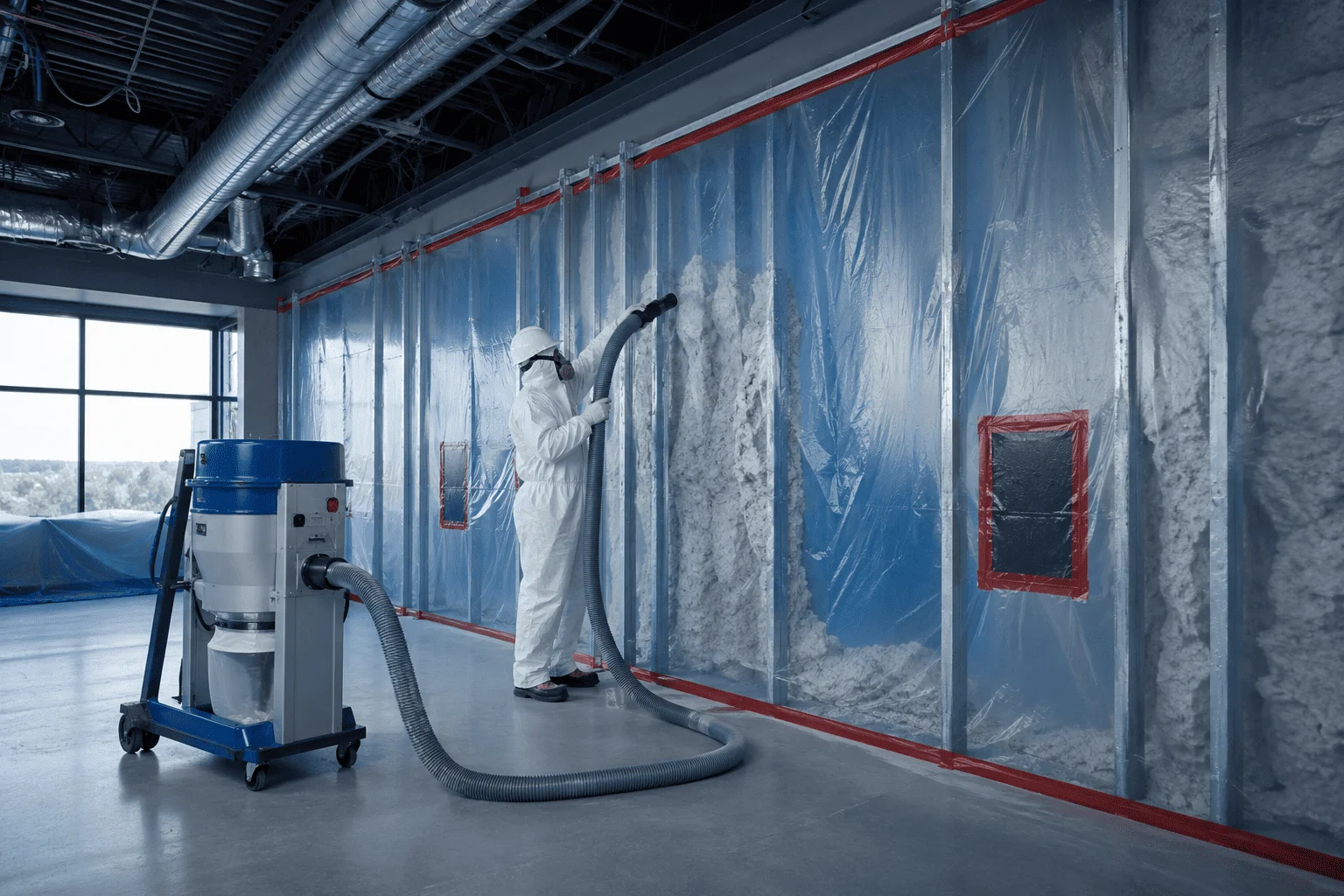
Yes. Degraded or contaminated material is removed under containment and disposed of, then the new system goes in as part of the same job.
Planning a commercial or industrial project?
Tell us the building type, where it's located, and what you need done. We'll review the details and get back to you.
Prefer to call? (850) 639-9272