In Springfield, pick closed-cell foam where an assembly must stop air and manage moisture, and fiberglass where a dry framed cavity just needs thermal fill. Given a local stock of healthcare and medical facilities and distribution and logistics warehouses, most projects end up using both rather than standardizing on one.
Which one fits a Springfield building
Asking whether spray foam beats fiberglass in Springfield is the wrong framing. The two solve different problems, and the local building stock, shaped by a healthcare, distribution, and manufacturing center, contains plenty of assemblies that call for each. The real question is what the assembly in front of you has to do.
What the Springfield market actually builds
Local work here runs from healthcare and medical facilities to distribution and logistics warehouses and offices and institutional buildings, with healthcare and distribution driving much of the demand. Healthcare and logistics anchors produce a balanced commercial and industrial mix. That mix is why a single recommendation does not travel well across the market: high-bay distribution space and a framed office fit-out in the same ZIP code want different systems, and the honest answer changes with the assembly rather than the address.
Where closed-cell foam earns its cost
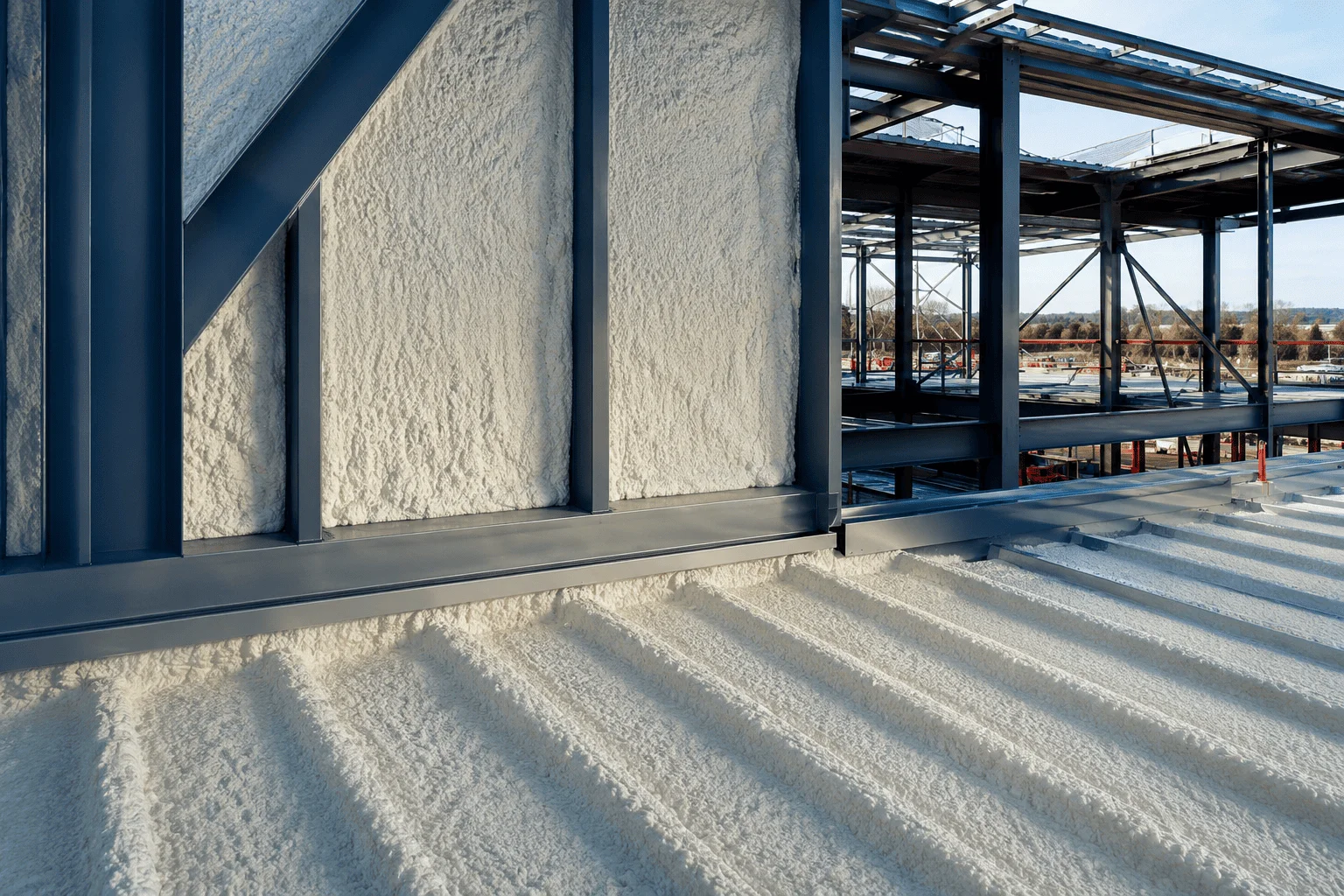
Closed-cell spray foam insulates and air-seals in a single pass, resists liquid water, and keeps warm humid air off cold steel. In Springfield that matters most on large roof decks and metal wall panels, where a continuous seal matters more than raw thickness. The continental mixed-humid climate puts wide seasonal swings near the top of the list, and foam addresses those directly rather than relying on a separate barrier to do it. Open-cell foam is a different tool again, common on interior walls where sound control matters more than moisture resistance.
When fiberglass is the efficient choice
Fiberglass batt and roll systems remain the efficient answer for office and dispatch build-outs inside the shell, where framed cavities are standard. They are inexpensive per unit, quick to specify, easy to inspect, and entirely adequate where an assembly is dry, framed, and already has a defined air barrier. What they do not do is seal. Left on their own in a Springfield building they will hit a nominal R-value on paper and still leak air at every transition, which is why they are normally paired with a dedicated air barrier rather than asked to work alone.
| Consideration | Spray foam | Fiberglass |
|---|---|---|
| Air-sealing | Excellent (closed-cell) | Limited on its own |
| Moisture control | Strong (closed-cell) | Requires separate detailing |
| Cost per unit | Higher | Lower |
| Best-fit use in Springfield | large roof decks and metal wall panels | office and dispatch build-outs inside the shell |
| Retrofit fit | Strong in accessible cavities | Moderate |
How to decide for your Springfield facility
A useful sequence is assembly, then goal, then budget. High-bay distribution space with a steel envelope and a real condensation risk points to closed-cell foam. Framed interior partitions in the same building point to fiberglass. Specifying one system for the whole Springfield facility is usually how money gets wasted at one end and performance lost at the other.
Conditions do not stop at the city line, but they do shift. If your portfolio extends into Kansas City, St Louis, the same assembly-first logic applies, though the local facility mix and climate exposure differ enough to be worth checking building by building.
Related pages
Frequently asked questions
Is open-cell foam an option for Springfield projects?+
Yes, mainly on interior walls and where sound control is the goal. It does not carry the moisture resistance of closed-cell, so it is not the choice for an exposed envelope in this climate.
Do you retrofit fiberglass buildings with foam?+
Where cavities are accessible and the underlying cause of any moisture problem is fixed first, yes. If the existing material is wet or degraded it comes out before anything new goes in.
Is spray foam or fiberglass better for Springfield metal buildings?+
Closed-cell foam is normally preferred on metal buildings because it controls condensation and thermal bridging on steel. Fiberglass suits framed assemblies far better than an exposed steel envelope.
Can one building use both foam and fiberglass?+
Yes, and it is common here. Foam takes the envelope, transitions, and moisture zones; fiberglass fills framed interior cavities at lower cost. Splitting the work that way is usually cheaper than specifying either one everywhere.
Does fiberglass air-seal a building?+
Not on its own. It is a thermal fill, not an air barrier. In Springfield buildings it is normally paired with a dedicated air barrier, or with foam at the transitions where leakage concentrates.
Planning a commercial or industrial project?
Tell us the building type, where it's located, and what you need done. We'll review the details and get back to you.
Prefer to call? (850) 639-9272