Neither system is better in general. Closed-cell spray foam controls heat, air and vapor in one application, which earns its cost on steel decks and moisture-exposed assemblies. Fiberglass performs to the same thermal target for less in a clean, correctly sized, accessible cavity. The assembly and its moisture exposure decide, not the product.
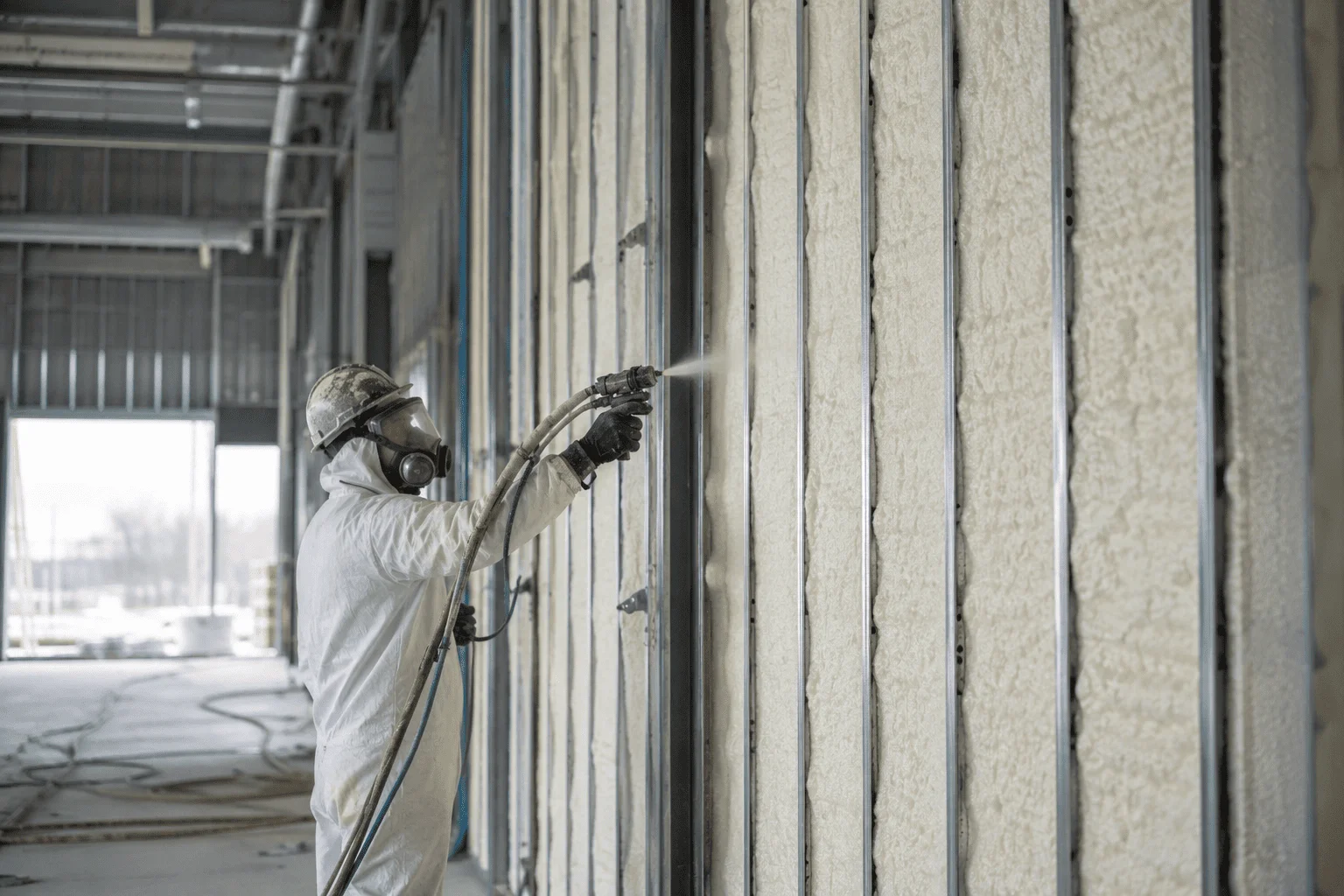
Decide on these five questions first
Most system arguments end quickly once the assembly is described properly. Before comparing products, answer the following about the specific surface being insulated.
- Is the surface continuous or irregular? Foam conforms to penetrations, odd geometry and unsealed transitions. Batt needs a defined cavity of the right dimension.
- Does the assembly need vapor control, or only thermal resistance? This is the question that most often decides between closed-cell and everything else.
- Can the assembly dry if it gets wet, and in which direction? An assembly that cannot dry is unforgiving of the wrong vapor strategy.
- Is the cavity accessible, and will it stay accessible? Future maintenance behind a foamed assembly is harder than behind removable batt.
- Does the space have a fire or acoustic requirement? Exposed foam plastic generally requires a thermal or ignition barrier; acoustic separation favours different materials than thermal performance does.
Closed-cell spray polyurethane foam
Closed-cell foam is the only one of the three that addresses heat, air movement and vapor in a single application. On an exposed steel roof deck or a metal building wall, where humid interior air reaching cold steel is the actual failure mode, that combination is what stops condensation rather than simply slowing heat flow. It also adds structural rigidity to light-gauge assemblies.
What it will not do is fix a wet building. Foam needs a clean, dry, sound substrate to bond to. Applied over a leaking roof or damp deck it conceals the problem and traps the moisture against the structure. It also requires ventilation and a re-entry period during application and cure, which an occupied facility has to plan around, and where it stays exposed it generally requires a thermal or ignition barrier.
Open-cell spray polyurethane foam
Open-cell fills and seals like closed-cell but stays vapor permeable and delivers less thermal resistance per inch. That permeability is a benefit in assemblies that need to dry inward and a liability in assemblies where vapor drive has to be stopped. In practice it does its best work on interior partitions, sound separation between tenancies, and irregular interior cavities where air-sealing matters more than vapor control.
Fiberglass, batt and blown
Fiberglass remains the sensible default in a framed cavity that is clean, dry, accessible and dimensionally correct. It reaches the specified thermal target at lower cost, it can be removed and reinstated for maintenance, and it does not require ventilation or a re-entry window during installation.
It is also the system most often installed badly. Batt compressed into an undersized cavity, cut short around bracing, or left with gaps at the edges loses a large share of its rated value, and fiberglass does nothing about air movement on its own. In an assembly where uncontrolled air leakage is the real problem, adding batt without an air barrier will not fix it.
Where each system is the wrong answer
The useful part of any comparison is knowing when to rule something out.
- Do not specify foam over a wet or unresolved substrate. Fix the leak first. The insulation is not the remedy for water entry.
- Do not specify closed-cell where the assembly must dry toward the interior unless the full assembly has been assessed for that drying behavior.
- Do not rely on batt alone where air leakage is the failure mode. It is a thermal material, not an air barrier.
- Do not use open-cell where vapor drive has to be stopped, for example on the warm side of a refrigerated space.
- Do not leave foam plastic exposed where a thermal or ignition barrier is required by the applicable code.
Buildings often need more than one system
Treating this as a single choice for a whole building is usually the mistake. A distribution facility can reasonably take closed-cell at the roof deck for condensation control, fiberglass in the framed office cavities, and open-cell around interior partitions for sound. Specifying one product everywhere either overspends in the easy areas or underperforms in the hard ones.
What to ask a contractor proposing either system
- Which assemblies is each system going on, and why that one
- What the vapor strategy is for the assembly, and which direction it dries
- What thickness or performance target is being priced
- Whether a thermal or ignition barrier is required and included
- What the substrate has to be in before application, and who is responsible for getting it there
- For spray-applied work, what ventilation and re-entry period the building has to plan around
Sources and technical references
The code, standard and safety statements in this guide come from the publishers below. Adopted editions and local amendments vary, so confirm what applies to a specific project with the authority having jurisdiction.
- U.S. Department of Energy, Insulation materials and where each is applied. Reviewed August 2026.
- International Code Council, International Energy Conservation Code, current adopted editions. Reviewed August 2026.
- OSHA, Respiratory protection and personal protective equipment standards. Reviewed August 2026.
Code requirements, product approvals, fire-protection details, and required R-values vary by jurisdiction, building use, assembly, and project conditions. Confirm requirements with the applicable authority, design professional, and project specifications.
Frequently asked questions
Is spray foam always better than fiberglass?+
No. Closed-cell foam is the stronger choice where an assembly needs air and vapor control as well as thermal resistance, which is common on steel decks and moisture-exposed assemblies. In a clean, correctly sized, accessible framed cavity, fiberglass reaches the same thermal target for considerably less.
Can spray foam be applied over existing insulation?+
It depends on the condition and the assembly. Material that is dry, sound and correctly fitted can sometimes stay. Wet, compressed or contaminated material should be removed, because foam applied over it seals the problem in and the finished assembly will not perform as specified.
Which system is better for a metal building?+
Metal buildings usually need condensation control at the structure rather than extra thickness, because the frame bridges heat and the steel surface can fall below dew point. Closed-cell foam or a purpose-built metal building liner system addresses that. Batt alone typically does not.
Does foam need a fire barrier?+
Where foam plastic remains exposed, a thermal or ignition barrier is generally required, and the specific requirement depends on the occupancy, the assembly and the adopted code. Confirm with the authority having jurisdiction rather than assuming a default.
Can insulation work happen while the building is occupied?+
Often yes, with planning. Spray-applied systems need ventilation and a re-entry period during which the area cannot be occupied, so the work is usually zoned and may be scheduled outside operating hours. Fiberglass does not carry the same re-entry constraint.
Planning a commercial or industrial project?
Tell us the building type, where it's located, and what you need done. We'll review the details and get back to you.
Prefer to call? (850) 639-9272