Insulation rarely fails all at once. It degrades through water intrusion, air leakage, compression, and physical damage, and the material can still look present while doing very little. The decision to replace rather than repair depends on whether the material is wet or contaminated, how much of the area is affected, and whether the underlying cause has been resolved.
Start with the symptom, not the material
Insulation is usually blamed for problems that begin somewhere else. Working backward from what the building is actually doing points at the cause faster than inspecting the material first.
- Condensation or dripping on steel. Humid air is reaching a surface below dew point. This is an air and vapor problem, and adding thickness alone will not resolve it.
- Staining, sagging, or visible water. Water is entering from above or condensing within the assembly. The source has to be found before anything is replaced.
- Uneven temperatures between zones. Usually air leakage at transitions and penetrations rather than insufficient R-value in the field of the assembly.
- Rising energy cost with no change in operation. Gradual degradation, often compression or displaced material, rather than a single failure.
- Noise carrying between tenancies. An acoustic separation issue, which is a different specification from thermal performance.
Conditions that genuinely warrant replacement
Some conditions cannot be recovered and the material has to come out.
- Saturated or repeatedly wetted material. Wet fibrous insulation loses most of its thermal value and does not reliably recover, and it holds moisture against the structure.
- Contamination. Material affected by sewage, smoke, mould growth, or pest infestation should be removed rather than covered.
- Compression and settling. Insulation squeezed into an undersized cavity or settled under its own weight cannot be restored to its rated thickness in place.
- Delamination or loss of adhesion. Material separating from the substrate is no longer part of the assembly, whatever its condition otherwise.
- Physical damage from trade traffic. Common in plants and warehouses where lifts, racking and maintenance access repeatedly disturb the same areas.
When repair or partial work is the better call
Full replacement is not automatically the right answer, and a contractor who recommends it before diagnosing the cause is worth questioning. Localised damage in an otherwise sound assembly can often be cut out and made good. Where the real problem is air leakage, targeted sealing at transitions and penetrations frequently delivers more measurable improvement than replacing material that is performing adequately.
The test is whether the remaining material is dry, intact, correctly sized and adhered. If it is, and the affected area is limited, partial work is usually the proportionate response.
Resolve the cause before installing anything new
This is the step most often skipped, and it is the one that determines whether the work lasts. Insulation installed over an unresolved roof leak, an uncorrected vapor strategy, or a mechanical system dumping condensate into an assembly will fail the same way the original did. The leak, the vapor path, or the mechanical fault is a prerequisite, and often a different trade.
What a proper assessment looks at
A remote diagnosis from a photograph is not an assessment. Evaluating an assembly means looking at the following on site.
- Where water is entering, or where the assembly is falling below dew point, and why
- Whether the air barrier is continuous through transitions, penetrations and changes of plane
- The condition, thickness and fit of the existing material across the area, not at one spot
- Whether the substrate is sound, dry and able to take a new system
- How much of the assembly is affected, and whether the damage is spreading
- What access, occupancy and scheduling constraints the building imposes on the work
What to expect from the scope that follows
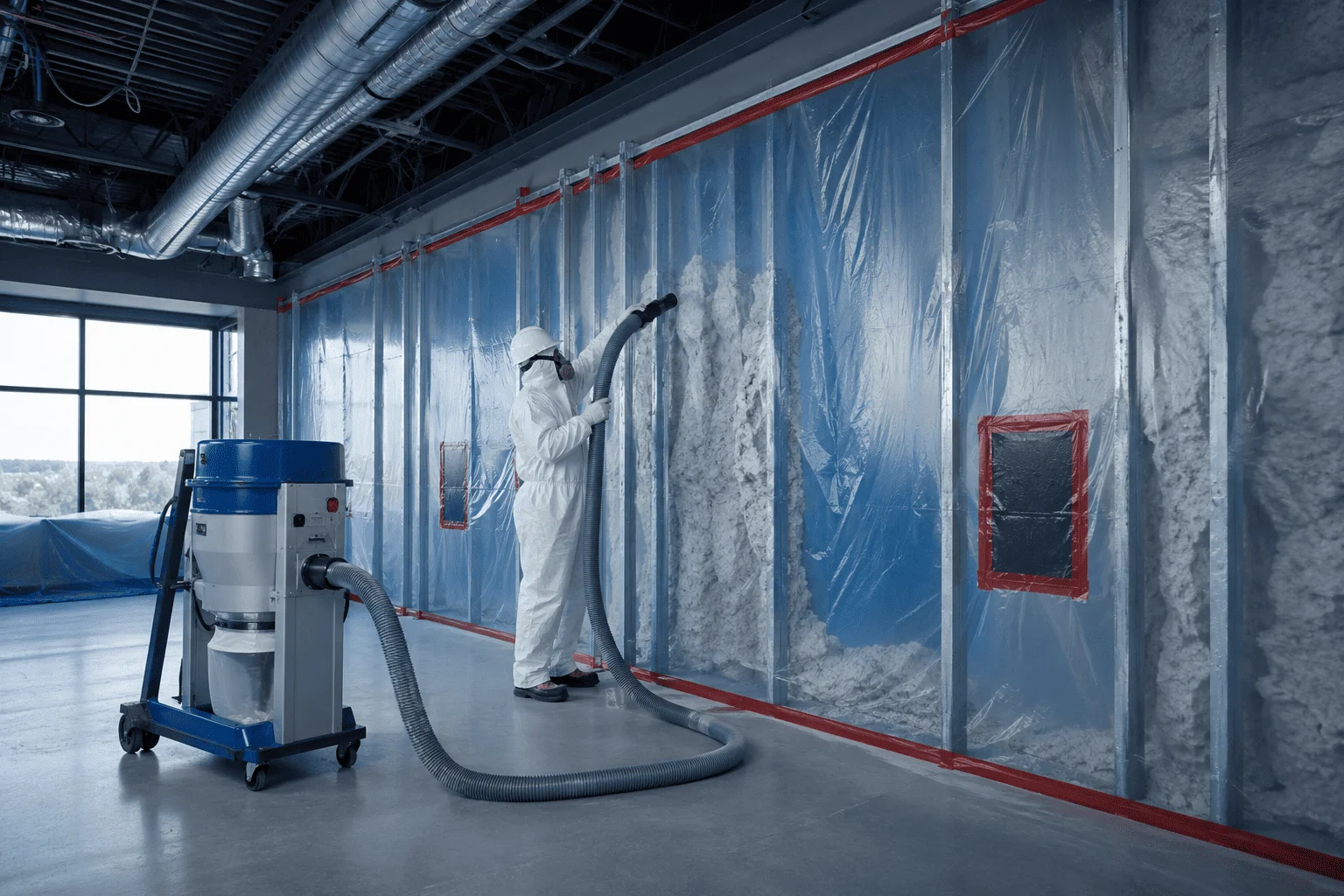
Once the cause is understood, the scope should state what comes out, what stays, what the replacement system is, and what has to be fixed by others first. Where removal is involved, containment and disposal belong in the scope, and in an occupied building so does the sequencing that keeps the facility running.
Sources and technical references
The code, standard and safety statements in this guide come from the publishers below. Adopted editions and local amendments vary, so confirm what applies to a specific project with the authority having jurisdiction.
- U.S. Department of Energy, Insulation materials and where each is applied. Reviewed August 2026.
- U.S. Department of Energy, Building Energy Codes Program, State code adoption and compliance resources. Reviewed August 2026.
- NOAA National Centers for Environmental Information, U.S. climate normals. Reviewed August 2026.
Code requirements, product approvals, fire-protection details, and required R-values vary by jurisdiction, building use, assembly, and project conditions. Confirm requirements with the applicable authority, design professional, and project specifications.
Related pages
Frequently asked questions
How long should commercial insulation last?+
In a dry, undisturbed assembly, many materials perform for decades. Service life is governed by conditions rather than age: water intrusion, air leakage, compression and physical damage from trade traffic are what end it, and any of those can occur within a few years.
Can wet insulation dry out and be reused?+
Occasionally, if the wetting was brief, the material is closed-cell, and the source has been fixed. Fibrous material that has been saturated or repeatedly wetted generally does not recover reliably and holds moisture against the structure, so removal is the safer call.
Do I have to replace everything, or just the damaged area?+
Often just the affected area, provided the remaining material is dry, intact, correctly sized and adhered, and the underlying cause has been resolved. Full replacement is warranted when damage is widespread or the material is contaminated.
Can you tell what is wrong from photographs?+
Photographs help, but they are not a diagnosis. Condensation, roof leaks and air leakage can produce very similar staining, and the correct scope depends on which one is happening and where the assembly is failing.
Is added insulation enough to stop condensation?+
Usually not on its own. Condensation means humid air is reaching a surface below dew point, so the fix is continuity of the air and vapor control layers, and in some assemblies a system that manages vapor as well as heat. Extra thickness over a discontinuous air barrier tends to move the problem rather than solve it.
Planning a commercial or industrial project?
Tell us the building type, where it's located, and what you need done. We'll review the details and get back to you.
Prefer to call? (850) 639-9272